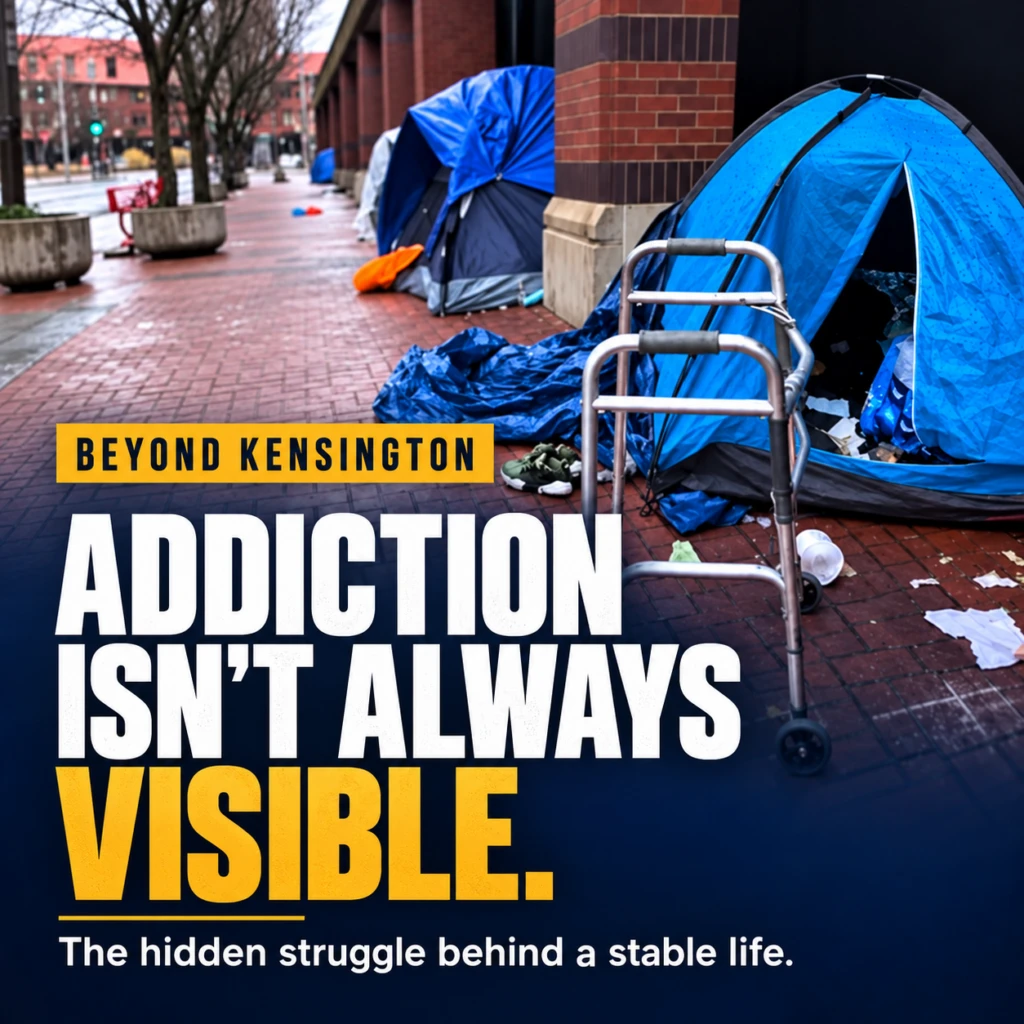
BEYOND KENSINGTON · ADDICTION & RECOVERY
Addiction Isn’t Always Visible: The Hidden Struggle Behind a Successful Life
A paycheck arrives. The bills are paid. Someone turns up for work, answers messages and looks like the person everyone expects. That can make a private struggle with drugs harder to recognize, especially when the public picture of addiction is built almost entirely from scenes of distress on the street.
The supplied Kensington video shows tents, belongings and people along city sidewalks. They also cannot establish any individual’s diagnosis. Beyond the frame lies another question: how do we recognize a serious problem when someone’s professional life still appears intact?

The Teenager Who Became Todd
In a February 2018 CNN report by Jessica Ravitz, a man called Todd described growing up with loving parents, good schools and a comfortable Midwestern childhood. CNN changed interviewees’ names to protect their identities. At 15 he tried a pain pill left over from his mother’s surgery. He remembered wanting to hold on to the feeling indefinitely. [1]
By the time of that report, Todd was 26, a college graduate working in corporate management, with an opioid addiction stretching back about 11 years. His career had progressed alongside the problem. He described periods of sobriety followed by a return to use, and a work persona that concealed what was happening privately. [1]
Those details belong to an archived account, not a new interview. Nothing in the supplied video identifies Todd or connects him to the people filmed in Kensington. His story matters here because it challenges the assumption that achievement and addiction cannot exist in the same life.
When Success Becomes Reassurance
The word “functioning” can sound comforting. But it describes what a person continues to do, not everything that person is experiencing. Completing a shift or earning a promotion cannot, on its own, answer whether drug use has become difficult to control.
Imagine how easily familiar achievements can dominate a conversation. A graduation, a good review at work and a busy calendar could become reasons for comfort. These are ordinary possibilities, not additional facts about Todd. They explain why asking only whether someone is successful can leave other questions untouched.
The danger in that narrow view is the threshold it creates. If help seems appropriate only after a job is lost or a relationship collapses, someone who still has both may struggle to believe their problem counts. Concern should not depend on whether suffering has become visible enough to satisfy a stereotype.
A Loving Home Is Not a Guarantee
Todd’s account also unsettles a familiar search for a single explanation. It can feel easier to understand addiction if there is one childhood event, one household failure or one obvious turning point.